
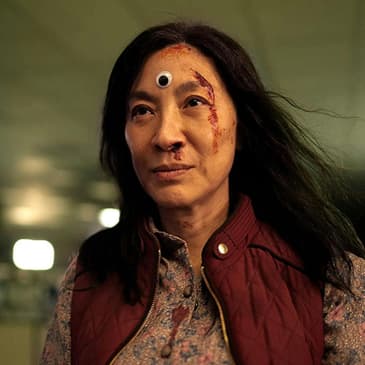

For this episode, Kristin and Ben discuss the 11-time Oscar nominated movie, Everything, Everywhere, All at Once; our favorite movie of 2022 by a mile! We take on subjects and themes that are beautifully interwoven through time, space, and taxes. Come verse jump through the complexities of love, family, and intergenerational trauma through the eyes of a woman just trying to set her path back to what it once was before life became so complicated. We hope you enjoyed it as much as we did!
Let us know what you’d like us to cover next. You can find our contact info and all our other shows at: podcastica.com
We’d love if you’d subscribe to / follow It’s Showtime, Folks! on your favorite podcast platform. You can find links by clicking Where to Listen at https://podcastica.com/podcast/its-showtime-folks.
Write or voice-message in and we'll respond to your feedback on the podcast. You can find our contact info and all our other shows at: podcastica.com
Learn more about your ad choices. Visit megaphone.fm/adchoices
[00:00:00] I know you're all fighting because you're scared and confused.
[00:00:15] I'm confused too.
[00:00:21] All day.
[00:00:22] I don't know what the heck is going on.
[00:00:28] But somehow, it feels like it's all my fault.
[00:00:33] Hey hey everybody!
[00:00:38] Welcome to the Podcast.
[00:00:39] I'm Kristen.
[00:00:41] And I'm Ben.
[00:00:42] And today we are talking about the 11-time Oscar-nominated movie, Everything Everywhere All At Once.
[00:00:49] So get your popcorn ready, sit back and relax because...
[00:00:54] It's Showtime, Folks!
[00:00:56] Yeah, so I've been wanting to podcast on this movie since the first time I saw it.
[00:01:11] I've been, to be honest with you, I never thought about podcasting on it until you
[00:01:15] brought it up.
[00:01:16] Oh really?
[00:01:17] And I don't know why I didn't think about podcasting on it because this movie is...
[00:01:23] I mean if you've listened to the Wilhelm podcast episode that you, me and Jason did
[00:01:29] where we talked about our top five favorite movies of 2022, this was my number one.
[00:01:34] Spoiler.
[00:01:35] And yeah, it was my number two and I think it was Jason's number one or two.
[00:01:39] We just, all three of us enjoyed it.
[00:01:42] And really everybody that I've spoken to, especially in our age group has really, really,
[00:01:49] really loved it.
[00:01:51] I spoke with my baby boomer aunt the other day and she said that she couldn't get past
[00:01:57] the first like couple of minutes.
[00:01:59] It just didn't grab her.
[00:02:02] And I think that that's really interesting because it presents as such a simple movie,
[00:02:08] it's such a complex journey to get to this very simple message.
[00:02:13] And that's something that I really loved about the movie overall.
[00:02:17] Yeah, I mean I agree with you completely is that it is, it's a very complicated...
[00:02:22] That's the weird thing like it's usually like the simple journey to get to like a complicated
[00:02:25] ending for some movies.
[00:02:27] But this is a very complicated journey to get to an ending that's incredibly simple.
[00:02:34] And that's not, I don't mean that in a negative way.
[00:02:37] Not at all.
[00:02:38] It's a beautifully, it's a beautiful way to tell a story.
[00:02:43] Mm-hmm.
[00:02:44] I mean and not only that but I mean you're taking a movie that has elements from every
[00:02:51] freaking genre of movie in this.
[00:02:54] It takes, I mean this movie literally is everything everywhere all at once.
[00:02:59] It's every, it takes elements from every kind of genre, every...
[00:03:04] Mm-hmm.
[00:03:05] Like that's God.
[00:03:06] It's a perfect movie about family and the choices we make in life.
[00:03:12] As well as how the world would be better off without the IRS.
[00:03:19] So...
[00:03:20] And their buttplug trophies.
[00:03:22] Oh my God, seriously.
[00:03:24] And the scene that comes up later with those trophies is just it's so good.
[00:03:31] I mean I rewatched this movie.
[00:03:35] It's a movie that the first time I watched it I knew.
[00:03:38] I was like, this is my favorite movie of the year.
[00:03:40] Like there's no question about it.
[00:03:42] It's my favorite movie of the year.
[00:03:44] And as badly as I wanted to rewatch it I was like, no, like I need to preserve
[00:03:51] how great this movie is.
[00:03:52] Like I can't watch this movie over and over and over again.
[00:03:55] You don't want to watch it to death.
[00:03:56] It loses its luster when you do that.
[00:04:01] I can see what you're saying there but I think that this movie,
[00:04:05] especially coming off of my second watch just right before we started
[00:04:08] recording this, is how much more I found in my second watch.
[00:04:12] And I'm sure if I were to watch it three, four or five more times
[00:04:15] that I would notice even more just because there's so many little details
[00:04:20] that are put into the movie throughout the entire film
[00:04:24] that you really only catch once you kind of relax into the story.
[00:04:29] Because the first time you watch it you're like, what the hell is going on?
[00:04:32] Yeah, you're kind of an overload of information.
[00:04:37] Especially for somebody that can't really handle a multiversal,
[00:04:41] multiversal, multiverse kind of movie who doesn't think in the abstract,
[00:04:47] who doesn't think outside the box as far as what their movie experience is.
[00:04:52] You may turn it off at hotdog fingers.
[00:04:56] Oh my God.
[00:04:57] You know what I mean?
[00:04:58] You may just be like, no, this movie is definitely not for me.
[00:05:02] I'm not going to.
[00:05:03] There's squirting ketchup and mustard into each other's faces.
[00:05:06] I don't get it. You know?
[00:05:08] Yeah. Yeah.
[00:05:12] I mean, and I get like.
[00:05:14] It's kind of almost hypocritical for me to say to that I don't want to watch it
[00:05:18] too many times because it loses.
[00:05:20] Luster, especially a movie this complicated.
[00:05:23] I actually, you know what?
[00:05:24] I don't even want to say complicated because it's really not.
[00:05:28] It's just a lot of information.
[00:05:31] You know, it's a lot of it.
[00:05:33] I don't mean actually it's not even information.
[00:05:34] It's stimulation to be completely honest.
[00:05:37] And it's.
[00:05:40] You know, to say that I don't want to watch it too many times
[00:05:42] because it loses its luster, but yet another movie on my top five list
[00:05:45] was Spirited, which I watched like 10 fucking times.
[00:05:48] Right. You know, so it kind of a hypocritical thought to say that.
[00:05:53] Well, it's interesting that you say that, though, just because
[00:05:57] I think that this movie first, first of all,
[00:06:00] anybody who's listening to this, I really hope got much more.
[00:06:06] Than a multiverse movie.
[00:06:09] I hope that when you watch this movie that you didn't just get
[00:06:14] this weird multiverse movie of this, you know, family
[00:06:19] and this woman that needs to save the universe because it's not what
[00:06:23] this is not what that movie is about.
[00:06:25] Right. To me, the movie is kind of in its simplicity
[00:06:30] with the complex journey of getting there.
[00:06:33] It's such a perfect metaphor of what our lives as individuals are.
[00:06:38] You know, we have this very simple existence.
[00:06:41] Really, we do, you know, we live, we're born, we live, we die.
[00:06:46] We make connections along the way.
[00:06:48] And it's our decisions that make our life complicated.
[00:06:52] It's us as individuals that make our life complicated.
[00:06:55] And really, when you bear it all down at the very end,
[00:06:58] it's really about who you love, who loved you and how you nurtured
[00:07:04] those around you.
[00:07:05] And this story to me is.
[00:07:09] This woman where in the part one, everything part
[00:07:13] life is crumbling around her.
[00:07:16] Everything is she's losing everything.
[00:07:19] Her marriage, her daughter, her her her laundromat.
[00:07:23] She's being audited by the by the IRS.
[00:07:25] It's just this.
[00:07:28] Crumbling of someone's life that they've struggled so hard to get.
[00:07:33] And then you get to the everywhere and you see that she's finally
[00:07:38] accepting all of it and she's taking it all in.
[00:07:40] But as she's taking it all in, she's realizing that there's only one thing
[00:07:44] that matters and she realizes it all at once.
[00:07:48] Right. In part three, that all that matters is her daughter, her husband,
[00:07:53] her happiness, her joy, her kindness.
[00:07:56] You know, and she sees that everybody has their own individual
[00:08:04] stripes and struggles and and issues from the guy with the raccoon friend
[00:08:09] to, you know, Deidre, the IRS woman who, you know, she's very unhappy
[00:08:15] in her own life and she projects that out in her job.
[00:08:19] You know, and then she sees her husband who is just this light in her life
[00:08:24] that she never fully appreciated till towards the end of the movie.
[00:08:27] And it's when that all comes into place for her that she's able to really
[00:08:31] love her life and appreciate where she is and and
[00:08:38] and kind of go from there, you know, at the end of the movie
[00:08:41] in that final scene, she's just staring at Weyman with this love
[00:08:47] of this glow of love over her face.
[00:08:49] And she's not even paying attention to whatever is happening in the audit
[00:08:52] because she has her husband and she has her daughter who's right there with her
[00:08:56] and she has her father who she just stood up to for the very first time in her life.
[00:09:02] Everything has fallen into place all at once for her.
[00:09:06] And I think that is the beauty of this story.
[00:09:10] Well, you even kind of hit the nail on the head, too,
[00:09:12] for anybody who thinks it's a multiversal
[00:09:15] and you were right to use that word the first time.
[00:09:17] Is that a word?
[00:09:18] It is now, OK, you know.
[00:09:21] But yeah, I mean, for anybody who thinks this is like a multiversal
[00:09:23] saving the universe kind of thing, it really isn't because when you watch
[00:09:27] this movie, especially upon the second viewing, which as much as I love
[00:09:32] this movie, the viewing I watched last night really was only my second
[00:09:35] viewing of this movie.
[00:09:36] And, you know, you start to realize that like, yes,
[00:09:41] there's there's all this multiverse travel and such within it.
[00:09:46] But it really has nothing to do with anybody outside of her.
[00:09:51] It's just her, it's her family and the characters that she interacts with
[00:09:55] in her own life.
[00:09:57] There's no saving the universe.
[00:09:59] It's saving her own world.
[00:10:01] Her universe, her universe.
[00:10:03] Exactly. Right. Like it has nothing to do
[00:10:05] with anybody else in the world around her except for her.
[00:10:09] And it's so easy to lose that in the story, to lose that thread.
[00:10:14] And I think that that's what we are supposed to understand is that
[00:10:18] it's so easy to lose ourselves in our lives
[00:10:22] that we forget what is actually important in our lives, you know,
[00:10:27] because we're every single, you know, as Wayman says in the
[00:10:31] beginning of the movie, like in the during the first like fight
[00:10:35] scene in the IRS building is that he's like every single one of your
[00:10:39] decisions or your failures. Hang on, I wrote it down.
[00:10:45] Well, blah, blah, blah, blah.
[00:10:46] I have a lot of notes, so just.
[00:10:50] Bear with us for a second.
[00:10:53] You need an index.
[00:10:55] I do need an index for this one.
[00:10:57] I absolutely need an index.
[00:11:00] So everything that she everything that she has, every single failure.
[00:11:09] I didn't write it down by a word of something else.
[00:11:11] Every single failure or every project that she hasn't finished
[00:11:15] or every small decision that she has made that has fractured off
[00:11:20] into a what could have been universe for her.
[00:11:23] And I think that we as people, we can get bogged down in
[00:11:27] what could have been in our lifetime if I hadn't gotten married,
[00:11:30] if I hadn't had a child, if I hadn't moved to America,
[00:11:33] if I hadn't ran off with this boy when my father told me not to.
[00:11:39] What would have happened in my life?
[00:11:40] And all of a sudden these branches of regret are now plagued in your life
[00:11:46] in your life, right?
[00:11:47] And so Wayman says as the fight is about to start,
[00:11:51] the first big fight is about to start is you either you have to make
[00:11:55] a choice to either live up to your ultimate potential or lie here
[00:11:59] in your own consequences.
[00:12:00] And in the beginning of the movie, she chooses to lie down.
[00:12:03] She says, I'm lying down.
[00:12:05] I'm choosing to lie down.
[00:12:05] I don't want to do this.
[00:12:07] But then you see her make those small decisions
[00:12:10] throughout the movie to eventually want to live up to her own potential
[00:12:15] and fight her battles and fight for her family.
[00:12:18] And she makes those decisions.
[00:12:19] And it's like she completely obliterates the alternate universes
[00:12:25] on the little phone pad.
[00:12:26] You know, it just all goes red because now she's made her life her life.
[00:12:32] And I just I love that so much.
[00:12:34] And I think it was done in such an out of the box creative way.
[00:12:38] I cried today.
[00:12:40] I cried the first time I saw the movie.
[00:12:43] The movie is just such an emotional roller coaster for me as a wife,
[00:12:46] as a mother, as a daughter.
[00:12:49] I had so many feelings throughout this movie on how it reflected on me as a
[00:12:54] as an individual.
[00:12:56] And then I just it makes me wonder who else had these huge emotional
[00:13:02] reactions to this movie?
[00:13:04] I know I absolutely cried the.
[00:13:08] I think the first time I watched it.
[00:13:13] I definitely I cried towards the end of the movie with her and Joy.
[00:13:18] I mean, that was that was a kind of the part where when I was watching it,
[00:13:22] was like why?
[00:13:23] Like, I didn't realize this movie was legitimately just about a woman's
[00:13:27] relationship with her daughter.
[00:13:28] Like that is the biggest connection in this movie.
[00:13:31] Like there's yes, there's a connection to her husband.
[00:13:33] There's a connection to her father.
[00:13:34] But it's mainly the biggest connection that she is kind of trying
[00:13:39] to save is the one between her and her daughter.
[00:13:41] It's the reason why her daughter is the villain of the movie
[00:13:46] or a multiverse version of her daughter is the villain of the movie.
[00:13:52] But the second time around when I watched it last night, like I started to cry
[00:13:56] more during even before that, I started getting choked up.
[00:14:02] And it was more towards the
[00:14:07] the parts with Wayman trying to
[00:14:11] like convince her that like she didn't need to be violent, that kindness was a weapon.
[00:14:16] And that was what he was trying to convince her to do.
[00:14:19] And it was the reconnecting with her husband that I started getting choked up.
[00:14:23] And then I kept I just kept crying until the end with everything with joy,
[00:14:27] because that's still that still gets me to.
[00:14:29] But I want to go back to something that you mentioned earlier,
[00:14:31] because this is something that I had in my head too, in that you mentioned regret.
[00:14:35] You know, you mention all these branches of them that are created in them
[00:14:39] in this in her multiverse because of decisions that she didn't make
[00:14:43] or decisions that she wanted to make and chose to go a different direction.
[00:14:47] And you know, regret is a big part of that.
[00:14:50] It's you regret the things that you didn't that you didn't do.
[00:14:53] She gets a vision of her life where if she didn't leave with Wayman and she stayed at home.
[00:14:58] Or I actually forget.
[00:15:01] Gong Gong.
[00:15:02] Well, well, Gong Gong, yeah, her father is the one that convinces her to
[00:15:05] stay and not leave with him.
[00:15:06] Is that the one where she becomes she basically becomes Michelle Yo.
[00:15:11] Yeah, she she becomes a famous martial arts actress.
[00:15:17] Yes. Again, she basically there's two of them.
[00:15:21] She basically becomes Michelle Yo.
[00:15:22] So there's two of them.
[00:15:23] There's the one where she becomes the martial arts actress.
[00:15:26] And then there's the one where she becomes the famous singer
[00:15:30] where her dad is waiting in the wings while she's singing the whole time.
[00:15:33] So there's there's two alternate universes with her and her father.
[00:15:38] Well, but I'm more thinking about the martial arts one.
[00:15:42] OK. And you're right.
[00:15:45] And they're both from, you know, she's this world where.
[00:15:50] She could have become this huge actress,
[00:15:53] you know, famous around the world and she has the regret.
[00:15:58] Because she even says that to Wayman, like, I saw what my life was like
[00:16:01] without you and it was beautiful.
[00:16:03] That's like that's hard.
[00:16:06] Correct. That's hard.
[00:16:07] That's heartbreaking to hear those are words that you say in a marriage
[00:16:11] that you can't take back. Yes, ever, ever.
[00:16:14] Yeah, exactly.
[00:16:18] And you shouldn't ever be able to take those words back.
[00:16:22] No, right.
[00:16:22] Except what you're fundamentally changing your marriage in that moment, I think,
[00:16:27] even even when when and if you get over that, there's still that conversation.
[00:16:32] There's still that those words that came out of your mouth.
[00:16:36] And you can't grab them and shove them back down your throat.
[00:16:40] Exactly. But, you know, that's her seeing that life that she could have had
[00:16:48] without him and seeing how beautiful it was, at least to her at the time,
[00:16:53] because she does continue on that timeline and she sees it later on
[00:16:57] that she does eventually get want to be with him again
[00:17:00] when she reconnects with him later on in that life.
[00:17:03] I found it very interesting that in a sense, in a very metaphorical sense
[00:17:08] is that when she taps into that life to use the martial arts to fight,
[00:17:14] it's using your regret as a weapon.
[00:17:18] Because that's basically that's basically what it is.
[00:17:21] She's tapping into a life that she regrets not having,
[00:17:25] at least in that moment in time.
[00:17:27] And she's using that regret, the martial arts that she takes from that as a weapon.
[00:17:34] Which by the end, when she realizes the life that she wants,
[00:17:37] is the life she had all along.
[00:17:39] That's what she was fighting for this entire time.
[00:17:41] She's basically using her regrets as a weapon to get what she wants.
[00:17:45] Well, to get that, I don't want to say it that way,
[00:17:49] because that kind of sounds off, but it's more she's using her regret
[00:17:53] as a weapon to find her own happiness, to get her happiness.
[00:17:58] Well, and I think that the way that she fights, too,
[00:18:00] is really interesting throughout the movie because she does use
[00:18:04] her regret to fight her battles in the beginning because she's so angry
[00:18:09] and she's so depressed.
[00:18:11] And so she's fighting.
[00:18:15] She's using her regrets to fight
[00:18:19] in the wrong way, right?
[00:18:21] The more that she fights using those regrets,
[00:18:24] kind of the more she's losing the battle, you know?
[00:18:28] And you can see when her life starts to fracture
[00:18:31] in like the conversation that she's having with Waymond in the.
[00:18:37] In the van, right, about about getting a divorce and
[00:18:42] and then the fight that she's having in the IRS
[00:18:47] office with with Deidre, with I think it's Alpha Deidre.
[00:18:54] The circle on the circle on the forehead is the alpha.
[00:18:58] OK, it's Alpha Deidre.
[00:18:59] Well, Deidre takes on many forms, too,
[00:19:01] because she's also the pro wrestling Deidre.
[00:19:04] She's hot dog fingers, Deidre.
[00:19:07] She's Alpha Deidre.
[00:19:08] She's bagel follower, Deidre.
[00:19:11] But yeah, I mean, and that's like the beautiful thing about this
[00:19:14] not to go off on another tangent.
[00:19:16] I'll just say it real quickly is that, yeah, these characters,
[00:19:20] every one of these actors, actors and actresses from Michelle
[00:19:23] Yo, Stephanie Sue, Jamie Lee Curtis, Keehu Kwan,
[00:19:27] James Hong, who is a freaking legend in the industry, legend.
[00:19:32] Legend actually doesn't even explain it like he is.
[00:19:37] He's been around a long time and he's done a ton.
[00:19:41] But they all deserve these nominations that they're getting
[00:19:45] and accolades that they're getting because they're not just playing one
[00:19:48] character in this movie.
[00:19:50] They have all taken on multiple.
[00:19:53] I don't think there's one actor in this movie who doesn't take on multiple roles.
[00:19:58] Well, even Jenny Slate plays different roles.
[00:20:01] And she's a small part of this movie, but we're getting
[00:20:05] getting ahead of ourselves because I do want to take it back to this fighting thing.
[00:20:09] Yeah, yeah, yeah. Sorry.
[00:20:09] And then no, that's OK.
[00:20:11] So she's taking her regrets and she's using them as her defense mechanism
[00:20:16] to fight back in a kind of a dirty way, a petty way.
[00:20:20] Right. But then you see her fighting technique as she channels more
[00:20:25] more of her branches of, you know, her alternate universes.
[00:20:30] It slowly morphs into alternate universes of ways that she
[00:20:36] could love somebody or, you know, forgive somebody or
[00:20:42] or have grace with somebody until finally at the end she's fighting
[00:20:46] and she's fighting up those steps, which I think is just such a pivotal part of this movie.
[00:20:52] And she's
[00:20:53] she's she's healing people, you know, the man whose neck that she, you know,
[00:21:02] I don't know, fixes, you know, with her karate chop moves.
[00:21:05] And he says, thank you at the end.
[00:21:07] Right. He's fighting his own personal battle.
[00:21:10] Right. And he's fighting against that personal battle because he's in pain
[00:21:14] and it makes him a different person.
[00:21:17] And then she just responds in kindness.
[00:21:19] She responds in love.
[00:21:21] She responds the way that Waymond has been trying to tell her the whole time
[00:21:25] to respond until she gets to the top of that stairs.
[00:21:29] And she just wants she just wants her daughter to feel all the love
[00:21:34] and all the acceptance that she feels in that moment, especially for her daughter.
[00:21:39] And her daughter is still resisting it.
[00:21:41] And her daughter is still wanting to go into that void,
[00:21:44] into that darkness of the bagel that she's created.
[00:21:48] And, you know, it's such a silly term to say that there's this bagel.
[00:21:52] But, you know, when you're watching these
[00:21:54] these people being sucked into this bagel and you're
[00:21:57] it's in that moment that you realize this is the void of depression.
[00:22:02] This is the void of unhappiness.
[00:22:04] This is where people go to the darkness and maybe they don't come out of it,
[00:22:10] you know, and her support system is trying to pull her out of it,
[00:22:14] pull her out of it until they have to let go and let her go.
[00:22:18] And then in that moment, we see the rock go off the cliff.
[00:22:20] We see her going to the void.
[00:22:22] We see we see the fall, basically of of joy, fall of joy,
[00:22:29] which again is another metaphor in her name.
[00:22:33] But then what happens after that is that Evelyn falls, goes off the cliff with her
[00:22:39] and she's prepared to risk everything to save her daughter.
[00:22:43] And she follows her off that cliff.
[00:22:45] She follows her into the void and they come out of it, you know?
[00:22:49] And she does this as a selfless act.
[00:22:51] She starts off as a very selfish, self-absorbed mother and she comes out of it
[00:22:56] as this selfless healer of a woman who only wants one thing and that is to save her daughter.
[00:23:03] And I just think that that may be the most beautiful thing I have ever seen in a movie ever.
[00:23:11] Well, that whole scene of finding up the steps is just phenomenal because,
[00:23:14] I mean, as you mentioned, it's, you know, this entire movie,
[00:23:18] we see her tapping into these other verses of herself to find strengths
[00:23:22] that other people have to use for herself.
[00:23:24] So she's not even using her own strength.
[00:23:27] She's using the strength of others.
[00:23:28] I mean, it's basically her, but it's other versions of her.
[00:23:31] So it's not really herself.
[00:23:33] And then we get to finding herself again.
[00:23:36] Yes.
[00:23:36] But then when we get to that scene, she's not tapping into herself.
[00:23:40] She's tapping into everybody else.
[00:23:41] As you mentioned, she's finding out what is the key, what has them in pain.
[00:23:47] And then that's what she's healing is rather than tapping into these skills
[00:23:51] that these other versions of herself have to defeat them.
[00:23:54] She's tapping into them and using their pain to heal them,
[00:24:00] which is which is such a great thing.
[00:24:02] And if you ever look at the behind the scenes of that or even some deleted scenes,
[00:24:07] there's one or two other ones that they actually ended up cutting out of that movie.
[00:24:11] They cut 45 minutes out of the movie.
[00:24:14] Well, one of the ones that they cut out of that scene was Jenny Slate.
[00:24:18] There's actually a version of that with Jenny Slate's character
[00:24:20] where she shows her on her phone.
[00:24:23] You find out that Jenny Slate is a divorced mom
[00:24:26] who does not have custody of her son.
[00:24:29] And she sends her like a video on her phone of her son asking her
[00:24:34] if she's coming to if she's coming to his birthday party.
[00:24:36] Yeah. And that's what heals her.
[00:24:38] And she's like, yes.
[00:24:39] And then she asks her how's your dog?
[00:24:42] And that kind of like.
[00:24:46] But what I kind of want to go into the thing that you mentioned
[00:24:49] with the bagel and everything, what I love about the metaphor of the bagel
[00:24:53] is they could have simply used a hole.
[00:24:56] Because I mean, you know, a hole is the center of a circle.
[00:25:01] And the circle represents at least to me watching that is just being stuck
[00:25:05] in a rut, like you were just going through the motions.
[00:25:07] It's the same things over and over again.
[00:25:10] It's just life constantly repeating itself over and over again.
[00:25:14] It's what creates that circle.
[00:25:15] It's what creates that void.
[00:25:17] But the use of a bagel rather than just creating a black hole or a void,
[00:25:23] I thought was great because it's an everything bagel.
[00:25:26] Yeah. And it's just it's everything in your life is what is
[00:25:31] repeating and it's what's creating this void.
[00:25:34] So to use a hole would have been fine, but to use an everything bagel
[00:25:38] was just a great metaphor to me.
[00:25:41] Yeah, so I don't know in what culture it is, but in and it's one of it is
[00:25:46] I believe it's an Asian culture.
[00:25:51] But if somebody wants to tell me what it is later, I don't know.
[00:25:54] But it a bagel is actually a slang term for zero or nothing.
[00:26:00] So to me.
[00:26:02] There is so.
[00:26:04] So.
[00:26:05] When you read interviews by the creators, Daniels, the two Daniels
[00:26:10] that created and wrote this movie,
[00:26:15] they wanted a major theme of of Roy's character
[00:26:19] to kind of represent nihilism.
[00:26:21] Nothing matters.
[00:26:23] Nothing is nothing.
[00:26:24] Everything, you know, everything is everything.
[00:26:26] And so when they were creating this void, they did talk about the circle,
[00:26:32] you know, and they said it was a joke that was a bagel.
[00:26:35] But the bagel just all of a sudden just took on this whole new meaning
[00:26:38] in this whole new character.
[00:26:40] And and so they left it in.
[00:26:42] So it was supposed to be kind of a joke, like a gag thing.
[00:26:45] But it ended up it ended up working really well for, you know,
[00:26:50] a whole theme of nihilism, especially when it comes to joy and.
[00:26:56] Right.
[00:26:57] What?
[00:26:57] Jobu Tupaki, Jobu Tupaki, who was the villain of the story,
[00:27:03] who had, you know, entered joy, joy is persona or joy is character.
[00:27:11] But what was interesting to me was that staying with Jobu Tupaki
[00:27:16] and the bagel and whatnot, Evelyn, her main goal was if I can become
[00:27:21] like her, maybe I'll be strong enough to save my joy.
[00:27:25] And so she knew that she had to go deep into the bagel, deep into the darkness.
[00:27:33] In order to save her joy or her daughter, but also her own joy.
[00:27:39] And I just thought that, you know, pushing through the darkness
[00:27:43] instead of running away from the darkness.
[00:27:48] Is also really an interesting
[00:27:51] path to take only because a lot of us think that
[00:27:56] not not us, but a lot of people who don't really believe that depression
[00:28:00] is a medical condition.
[00:28:05] Would think just choose not to be depressed.
[00:28:07] Just choose to be fine, you know, just, you know, look at the darkness
[00:28:11] and just say, no, I'm not going to do that today.
[00:28:13] Sometimes you need to go through the darkness to come out of the darkness
[00:28:16] and realize that you're able to get out.
[00:28:18] Sometimes there's something that you need to experience in that darkness
[00:28:21] in order for you to grow or evolve as a person.
[00:28:25] And, you know, whether or not that was intentional on the from the writer's standpoint,
[00:28:30] I definitely took away an element of that after watching the movie.
[00:28:36] How about you?
[00:28:37] No, I definitely mean you kind of hit the nail on the head
[00:28:40] with people saying that like depression, like just choose not to be depressed.
[00:28:44] That's it's not that easy.
[00:28:45] I've been there.
[00:28:47] I know a lot of people who have been there.
[00:28:51] So like I kind of I see exactly where you're coming from.
[00:28:55] And I think that's one of the reasons why the end of this movie hits
[00:28:58] as hard as it does.
[00:29:00] And it makes people as emotional as it is because there are a lot of people
[00:29:03] who kind of find relation in everything that these people
[00:29:09] are going through, whether it be, you know, conflicts or fractures
[00:29:14] in their own family, their own family existence or dealing with depression
[00:29:20] or dealing with overbearing parents or just.
[00:29:24] It's it's amazing how this one family has so many things that happen to them
[00:29:28] that different people can find relatable.
[00:29:35] But I do I do want to kind of say one thing
[00:29:39] that if if I remember correctly,
[00:29:42] when it comes to joy going into the void,
[00:29:46] like falling backwards into the bagel at the end.
[00:29:51] I don't think Michelle Yo's character actually goes into the void to get her.
[00:29:56] She doesn't follow her into the void.
[00:29:57] She lets her go.
[00:30:00] And it's not. But she does as the rock.
[00:30:03] She falls off the cliff behind her.
[00:30:06] She falls off the cliff as if she's willing to
[00:30:08] to to to find to let or to be with Joy to go that route with her.
[00:30:16] But when it comes to the scene in the void, it's actually joy that reaches out.
[00:30:22] Michelle Yo never goes into the right joy reaches out for her.
[00:30:26] And it happens after and it happens after the rock goes over.
[00:30:31] Yes, the side after the Evelyn rock goes over the side to go after her.
[00:30:36] Is when Joy.
[00:30:39] In the in, I guess the Alphaverse finally reaches out of the darkness to grab on to.
[00:30:46] Evelyn, because it's because she's seeing all these different versions
[00:30:49] of Evelyn willing to make that journey with her, right?
[00:30:53] That she realizes I need to be with my mother and then
[00:30:58] she reaches out for Evelyn and Evelyn pulls her out of the void.
[00:31:02] She was willing to let her go.
[00:31:05] Yeah. And you know what?
[00:31:06] I think that that's really that's an important distinction to make.
[00:31:09] So I'm glad that that you corrected me on that because ultimately
[00:31:14] we have to pull ourselves out of our own darkness.
[00:31:18] Yeah, because we don't we can't always.
[00:31:21] I mean, it's great to have help,
[00:31:24] but we have to help only works better if we ask for it
[00:31:30] rather than be forced to take it because we have to be willing
[00:31:35] to do it. Right? You can resent forced help.
[00:31:37] If somebody forces their help upon you, you can resent that and it even makes
[00:31:41] you push it away even harder sometimes.
[00:31:43] But when you realize that you can accept the help to make yourself a better person,
[00:31:51] that's what helped genuinely actually helps because that means
[00:31:54] you're willing to make the journey.
[00:31:56] Right. Like we can't do anything alone.
[00:31:59] Nothing is ever accomplished alone, but we have to be willing
[00:32:03] to put in the work as well ourselves.
[00:32:07] You know, it's no it's no secret.
[00:32:09] Anybody that has listened to me on any number of podcasts
[00:32:12] that I've been in the past is that, you know, I have a sister who passed away.
[00:32:17] She had a deep addiction problem.
[00:32:21] That's not why she passed away, but she did have a deep addiction problem
[00:32:24] that complicated her life pretty much.
[00:32:28] And letting go of her and letting her find her way to reach out finally for help.
[00:32:39] That's an extraordinarily difficult thing to do.
[00:32:41] Yeah. To let go, especially of somebody that you love so much.
[00:32:46] It's it's and for a parent to do that, to let go and and let
[00:32:51] and be willing to watch their child fall
[00:32:54] and still be there for them when they're when they're ready to pick themselves back up.
[00:32:59] That's borderline impossible.
[00:33:02] You know, and so I I love that these that these directors, the Daniels
[00:33:10] that they didn't really shy away from that theme.
[00:33:13] They didn't you know if it was there if you wanted to see it.
[00:33:16] It was there if you could relate to it.
[00:33:18] And I hope that there's a lot of people, a lot of people who saw this movie
[00:33:25] that did take that away because I think with the mental health crisis
[00:33:29] that we're having right now, like in our country.
[00:33:34] That this movie is such a beautiful reminder that there is light in the darkness.
[00:33:38] There is help if you need it.
[00:33:41] And it's a complicated, messy journey there.
[00:33:47] But it's there.
[00:33:48] Yeah, you know, and it's there for a reason.
[00:33:51] And it can be silly.
[00:33:52] It can make zero sense at all.
[00:33:54] It can be filled with, you know, build those, I guess,
[00:33:58] and hot dog finger hands and but plugs and but plugs.
[00:34:03] But, you know, if you come out of it,
[00:34:06] you can have a really beautiful life, you know, and life is beautiful
[00:34:10] and it's messy, man.
[00:34:12] Oh my gosh, life is so messy.
[00:34:13] But, you know, I think from the end and the movie really, really shows it.
[00:34:20] Man, life is so awesome and it's beautiful and it's gorgeous and it's simple.
[00:34:25] It's just love others and be kind to yourself.
[00:34:29] Well, and I think some of the other cool elements of I mean,
[00:34:33] and this could absolutely be reading too far into things
[00:34:36] because we got nos as podcasters, we tend to overanalyze stuff
[00:34:41] to the degree.
[00:34:42] I understand that.
[00:34:43] But this movie, this movie, I believe is OK to take this
[00:34:47] deep of an existential dive on.
[00:34:49] Yes, but I like how like the two elements with the bagel
[00:34:54] are the first time you see the bagel and it's a small.
[00:34:58] It's literally just a bagel, like there's no void in between.
[00:35:01] It's literally just life kind of repeating itself.
[00:35:04] But it's in this brilliant white room
[00:35:08] like the extreme contrast of light to dark with this black
[00:35:13] everything bagel in this brilliantly lit white room.
[00:35:17] I loved that contrast, but then I loved how later
[00:35:21] you know, and everything is kind of calm, like, you know,
[00:35:25] it's there, but you're not too worried about it.
[00:35:28] And then later when we see the bagel and become the actual void,
[00:35:33] it's not in this room anymore.
[00:35:35] Now it's in this office building with all these other people.
[00:35:38] And I think that alone is a great metaphor for how if you let
[00:35:42] things spiral that far out of control, sometimes in your own life,
[00:35:46] it will affect all the other people around you.
[00:35:50] It doesn't just affect your family any longer.
[00:35:53] It's going to affect other people that you're connected to.
[00:35:57] And so moving the bagel from because that battle could have
[00:36:00] taken place in that white room and it would have been just as stupendous.
[00:36:04] But to move it into the actual world with all these other characters now,
[00:36:09] like I said, it's just a great metaphor for how when things get that bad,
[00:36:14] it's going to affect other people.
[00:36:16] It bleeds out into every facet of your life.
[00:36:19] Absolutely. 100 percent.
[00:36:22] Yeah. So.
[00:36:26] I really like the way this movie is set up with the three parts.
[00:36:31] We have part one with everything.
[00:36:34] We have part two with everywhere.
[00:36:35] And then we really have just it's almost like like a coda, right?
[00:36:40] Parts three. It's a prologue.
[00:36:42] All at once. No, part three all at once.
[00:36:44] It's the end. Yes. Right.
[00:36:46] It's it's the end of the movie.
[00:36:48] It's very short, but it wraps up
[00:36:51] what the previous two parts had been trying to do.
[00:36:57] Maybe what do you think?
[00:36:59] I like the way that the movie set up in.
[00:37:01] No, I agree with you.
[00:37:02] The parts I agree with you.
[00:37:03] I think it's three acts.
[00:37:04] I think it's great in three acts and.
[00:37:09] You know, the everything part of it,
[00:37:11] the first chapter of it is literally everything that's happening in her life.
[00:37:14] It's a great introduction to that.
[00:37:15] And we're seeing what it does to her.
[00:37:18] The everywhere is literally the splintering of her of herself
[00:37:22] and going in all these different directions, which not just in the
[00:37:26] multiverse, but in her own life, like she's trying to be in pooled
[00:37:30] in all these different directions.
[00:37:32] That's the everywhere part.
[00:37:33] And then the all at once is kind of the harmony of everything.
[00:37:37] It's the balance.
[00:37:39] It's it's being able to take everything that's happening
[00:37:42] everywhere it's happening and just be in the moment,
[00:37:45] which is the all at once.
[00:37:47] And it's it's a great Coda like you meant like using that word Coda.
[00:37:51] It's it's a great finish.
[00:37:53] It's finally her balancing out her life.
[00:37:57] And then when we get that final moment where she's kind of hearing
[00:38:00] everything that's happening, but Deidre pulls her back out of it.
[00:38:04] And she's living up to the promise that she made to Joy, that she will be there.
[00:38:09] She doesn't need to be everywhere else.
[00:38:11] Right. Right. Absolutely.
[00:38:13] But I also like to.
[00:38:16] If you think about it, the conversation that Deidre is happening
[00:38:21] is having with them like you've made improvements.
[00:38:25] Everything's better.
[00:38:26] But it's not there yet.
[00:38:28] It's like, OK, she's even telling you there's room to grow.
[00:38:33] She says, well, she says, you listen to me, but you really did.
[00:38:37] But you also didn't listen to me.
[00:38:38] Yeah. So like she and herself is almost like a narrator of their story
[00:38:44] in that moment because she's saying like you did good.
[00:38:47] There's still more to go.
[00:38:49] This is you're not there yet.
[00:38:52] Like it's not perfect.
[00:38:54] But you can still keep going.
[00:38:57] Yeah, absolutely.
[00:38:58] And I love that.
[00:38:59] And isn't that the truth?
[00:39:00] Right. You don't come out of it like all better, you know, when you dust off
[00:39:04] your pants and you keep going, you're just like, OK, like now I'm going to work
[00:39:08] and I'm going to do the work and it's going to get a little easier every day.
[00:39:11] And I'm going to have good days.
[00:39:12] I'm going to have bad days.
[00:39:13] But I'm going to be here for my family.
[00:39:16] I'm going to honor what I've made of my life.
[00:39:20] I'm going to appreciate it.
[00:39:22] Well, I mean, as weird as this may seem, and I'm literally just thinking about this now.
[00:39:28] Deidre auditing that family and them risking losing their laundromat
[00:39:34] because of everything, the mistakes that they've made.
[00:39:37] This movie, in a sense, is the audit of their life.
[00:39:42] And you're absolutely correct
[00:39:45] because they are looking at everything.
[00:39:48] They are in risk of losing their family because of mistakes that have been made
[00:39:53] and they need to correct those mistakes so that they don't.
[00:39:55] Similar to how they have to.
[00:39:59] Change things, they have to prove different things with their receipts
[00:40:02] so that they don't lose the laundromat.
[00:40:04] This movie, everything that happens is the audit of their life.
[00:40:09] Of Evelyn's life of Evelyn's life.
[00:40:11] Well, yeah, of of the Wanks of the Wang family.
[00:40:16] Yeah, because because by the end,
[00:40:19] it does improve the relationship with her joy.
[00:40:22] It improves the relationship with her and Gong.
[00:40:24] It I mean, it is mainly OK.
[00:40:25] So you're right, it is her life, but it affects the rest of her family.
[00:40:31] Well, yeah, I mean, as a mom, the mom rules the house.
[00:40:34] Sorry, guys. You know.
[00:40:37] What mom says goes so not just a mom's not right.
[00:40:41] Oh, if mom's not right, the house isn't right.
[00:40:43] And that's I mean, I've experienced that firsthand as a daughter and as a mother.
[00:40:47] You know, disagreeing with you.
[00:40:48] What? No, you shouldn't know.
[00:40:51] Well, in the very beginning when this movie was first
[00:40:56] being made, the Daniels tried to keep the plot under wraps by saying
[00:41:01] that the movie was about a woman who tries to do her taxes.
[00:41:04] And that was it.
[00:41:08] It's it's not a lie.
[00:41:11] It's not a lie. No, it's not.
[00:41:13] It's really not a lie.
[00:41:16] One bit.
[00:41:19] It's kind of brilliant.
[00:41:20] It's too bad it didn't stick, but, you know, it would have been awesome
[00:41:23] if that's just all it ever said, you know, if that's all the summary
[00:41:29] or the plot was right.
[00:41:34] So that would have been great.
[00:41:36] So I love.
[00:41:37] Do you have do you have a point that you want to take on?
[00:41:40] I have all these points that I feel like I'm guiding the entire.
[00:41:44] I'm totally fine with you guiding the conversation, because as you and I talked
[00:41:48] about before we started recording, I just did.
[00:41:51] I did not take any notes because even upon my second viewing,
[00:41:55] I just got so drawn back into just watching.
[00:42:00] And there's so much that happens in the movie that I felt like if I look
[00:42:04] down for any point to take notes, I was going to miss something.
[00:42:09] I have a lot of writing that I did as I was watching, but I did pause a lot.
[00:42:14] So it's not in the lines.
[00:42:16] Right. It's all over the page.
[00:42:18] It's all over the page. It's everywhere.
[00:42:20] I'm fine just kind of going along with like just talking about any points
[00:42:24] that you make. Awesome.
[00:42:25] I'm sure I have stuff to say about all the points that you're making.
[00:42:29] Awesome. That that makes me feel very excited because now I get to just go for it.
[00:42:33] Take the lead.
[00:42:36] So in the everywhere.
[00:42:39] So I don't want to go to everywhere just yet.
[00:42:41] Well, I'm kind of bouncing all over the place, but I noticed from the very beginning,
[00:42:45] the opening shot of the movie is of a mirror.
[00:42:48] Right. Yes.
[00:42:48] And we see kind of what's happening with the family through the mirror.
[00:42:53] Right. And then as we go to
[00:42:58] when we go to the laundromat,
[00:43:01] we see a shot of the movie through one of those like mirrors that you can see
[00:43:05] around the other side or something like that.
[00:43:08] And then as there was a conversation between Evelyn and Joy about the party
[00:43:15] or no, about how Joy wants to introduce Becky to Gonggong as her girlfriend.
[00:43:24] You see in the background all of the cameras
[00:43:27] and you see Waymond is becoming Alpha Waymond
[00:43:30] and he's sliding all over the place in the cameras and stuff like that.
[00:43:33] And then he goes back.
[00:43:34] So there's a lot of reflection that's happening in the first
[00:43:39] in the first 20 minutes, 30 minutes of the movie.
[00:43:42] And then it's not until we get to the the IRS office that the mirror
[00:43:47] or, you know, the fourth wall, the screen begins to crack, cracks into two.
[00:43:52] Right. And so that mirror begins to crack.
[00:43:55] The subtitles crack and you can see subtitles in both sides
[00:43:59] in a broken sense in the movie.
[00:44:02] And then as we move to everywhere,
[00:44:05] as all of her universes kind of start to crack open
[00:44:09] and right before she vomits everywhere, that crack turns into about
[00:44:14] turns into almost a shatter on the screen.
[00:44:16] And you just see that
[00:44:19] she is overwhelmed with
[00:44:23] with all of her shoddakutta wood is and trying to fix her family, that she just
[00:44:28] you know, we talked about it in our other podcast.
[00:44:31] She just kind of mentally, verbally
[00:44:33] vomits literally all over the carpet.
[00:44:36] Right. And it's almost like she needed to just
[00:44:40] urge it all out in order for her to make any sense.
[00:44:43] Because after that happens, you know, you see that
[00:44:48] she's.
[00:44:50] Finally, strong enough to
[00:44:54] stand up to Gong Gong.
[00:44:56] And so she actually stands up to Gong Gong.
[00:45:03] Right after that in the office scene, like they go from
[00:45:06] the IRS and then they go into that office
[00:45:09] and it's right before they go into the.
[00:45:15] Whatever you call it.
[00:45:17] What do you call it when people have submissives and and.
[00:45:22] Oh, the.
[00:45:24] The.
[00:45:26] It's basically a sex dungeon.
[00:45:28] Yes, a sex dungeon, but it's a it's
[00:45:31] Bido or Bado or, you know what?
[00:45:34] Whatever, I don't know because I.
[00:45:37] I'm stupid, but Evelyn finally protects joy from Gong Gong.
[00:45:42] Alpha Evelyn has realized that she has pushed alpha joy so hard
[00:45:46] that she broke alpha joy.
[00:45:49] And that's why alpha joy is the way that she is.
[00:45:51] So now her father is telling her or alpha Gong is telling
[00:45:56] her in this office, you need to kill this joy right now.
[00:45:59] If we're going to save the universe, like let's just get it over with.
[00:46:03] She's all tied up in the chair, like do it now.
[00:46:05] And she has she has the box cutter in her hand.
[00:46:09] And she's going towards and she frees her instead.
[00:46:11] And she turns around and she confronts her father for the first time.
[00:46:15] And she says, I'm not going to do this.
[00:46:18] I can become like her.
[00:46:19] Maybe I'll be strong enough to save my joy.
[00:46:22] So I'm not going to do it your way.
[00:46:23] I'm not going to do it the way that you told me to do it.
[00:46:25] I'm going to do it my way.
[00:46:26] And I'm going to try and save my daughter by not killing her any more
[00:46:30] than I already have.
[00:46:32] Well, it's interesting.
[00:46:33] And good.
[00:46:34] Go ahead.
[00:46:35] I was just going to say it's in the.
[00:46:37] Go ahead.
[00:46:38] I was just going to say it's interesting, too, when she makes that
[00:46:40] choice right then and there, too, if I can kind of be like her or, you know,
[00:46:47] kind of become do the same things that she does and be everywhere
[00:46:51] this way that she is, then maybe I can save her rather than defeat her.
[00:46:55] And then when you watch that, especially when we go into the
[00:46:58] everywhere part of it, you realize that almost breaks her, too.
[00:47:02] Like she almost becomes another alpha joy.
[00:47:07] Or.
[00:47:09] What's the the?
[00:47:12] What's her name?
[00:47:14] I haven't written down to Paki.
[00:47:16] Jobu, that's yeah.
[00:47:18] It's just so fun to say.
[00:47:20] Well, I hear Jobu and I think majorly, but OK.
[00:47:25] But yeah, like she almost becomes that version of herself
[00:47:29] the same way that joy has become that version of herself.
[00:47:33] But it's it's it's wayman that kind of brings her out of that
[00:47:39] and saves her from that, which lets her then save joy.
[00:47:44] At the same time.
[00:47:46] Yeah. Well, I think that during.
[00:47:49] I think that during her journey to become like joy, she realizes
[00:47:55] that Evelyn and Joy or the viewer watches Evelyn realize
[00:48:02] that she has the same struggles as her daughter.
[00:48:06] Her daughter only wants her mother's approval, right?
[00:48:10] And it's just she's she's destroying everything around her
[00:48:13] to get her mother's attention so that she can get her mother's love and approval.
[00:48:18] And Evelyn is starting to realize that her whole life has been doing the same.
[00:48:25] Her father has never approved of her, has never been proud of her.
[00:48:29] And she's done everything to try.
[00:48:32] She's almost killed her life trying to make that a reality.
[00:48:38] You know, she's.
[00:48:40] She's so focused on this laundromat being successful
[00:48:43] that she's neglected her marriage and now that's crumbling
[00:48:46] and she's about to have a divorce.
[00:48:47] Her daughter is literally pulling away from her
[00:48:51] and wants nothing to do with her because all Evelyn can think about
[00:48:55] is how can I get my father to love me the way that I want him to love me?
[00:48:59] And then in that realization, that joy is doing the exact same thing.
[00:49:05] To her, I think that that's where the fight in Evelyn starts to unravel
[00:49:11] where she where she actually unclenches her fists.
[00:49:15] And there's a scene where it shows her unclenching her fists and she is done fighting.
[00:49:22] She's done fighting her father and she's ready to just start accepting.
[00:49:28] She's going into this acceptance phase where she she's accepting her husband.
[00:49:32] She's accepting her life.
[00:49:33] She's accepting her daughter and she's realizing how much she loves them.
[00:49:37] Well, that's what that whole unclenching her fists to is right after
[00:49:41] Wayman gives that whole speech about being able to use kindness as a weapon.
[00:49:45] Right. And then she kind of reflects upon her own life
[00:49:47] and she sees that from different from different perspectives of her life
[00:49:51] and realizes that's true.
[00:49:53] And this is a wayman who she literally just stabbed to like he
[00:49:58] like she tried to kill him and he's still giving her this speech
[00:50:03] about how kindness can be a weapon instead of violence.
[00:50:06] And that's when she unclenches her fist and everything changes for Evelyn.
[00:50:10] Right. Well, and it's interesting because a lot of us when we.
[00:50:16] When someone and I'll speak to this personally.
[00:50:21] When you go to a dark spot, when you go into what kind of a
[00:50:26] just a depression state,
[00:50:30] you want to destroy everything good in your life because you're at this mental
[00:50:34] point where you don't think you deserve anything good.
[00:50:37] And so right.
[00:50:39] And so her stabbing her kind husband, her destroying her daughter,
[00:50:44] who she's named Joy, right?
[00:50:46] So she's literally destroying joy.
[00:50:49] She's destroying kindness.
[00:50:50] She's destroying the good parts of her life.
[00:50:53] It's remarkable to watch in in the beautiful way that these directors have done.
[00:51:02] Her it is beautiful to watch her realize that she doesn't have to destroy
[00:51:07] everything good in her life, that once she welcomes and accepts
[00:51:11] everything good in her life, she can defeat her demons
[00:51:15] and she can help her daughter defeat her demons.
[00:51:19] You know, the googly eyes as silly as they are,
[00:51:24] they have such a wonderful, albeit silly, but a wonderful
[00:51:31] representation of in this movie where there is a yin and a yang
[00:51:37] in this in this movie.
[00:51:38] And the yin is the and I don't know which is which.
[00:51:41] I know that one is one is light, one is dark, right?
[00:51:44] But one is the bagel.
[00:51:47] And the exact inverse of that bagel is a googly eye, right?
[00:51:52] Instead of having a white center and a black circle, we have a black center
[00:51:57] and a white circle, right?
[00:51:59] So the the googly eye, which represents the silliness, the kindness,
[00:52:03] the love that is being replaced or that is being balanced by the bagel,
[00:52:08] which is now representing, you know, the darkness and loneliness, despair and anger.
[00:52:14] So when Evelyn puts that googly eye on her forehead,
[00:52:18] she is literally going against the exact opposite of that
[00:52:24] with everybody that has the bagel drawn on their forehead,
[00:52:28] which is the exact opposite, which I think is really, that's really great.
[00:52:32] So when, you know, so wayman, who is seen as weak,
[00:52:36] but he chooses kindness over fighting, he wants others to stop fighting
[00:52:39] due to fear and confusion and choose kindness.
[00:52:42] He wants his wife to stop fighting the wrong way and fight for joy,
[00:52:46] fight for love, for connection, for family.
[00:52:49] He wants her to fight for him and for their marriage.
[00:52:51] And I think that when she unclenches her fists
[00:52:55] and she puts that googly eye on her forehead,
[00:52:57] she is ready to do exactly what her husband has been screaming
[00:53:02] for her to do the whole time.
[00:53:05] Well, I love to that.
[00:53:06] I really loved the whole the googly eye on the forehead part
[00:53:10] of the film as well, because if you're not familiar with the third eye,
[00:53:14] the third eye is kind of like it's always been thought of as a mystical
[00:53:17] and visible eye that lets you see things that you don't usually see
[00:53:21] with your ordinary eye.
[00:53:22] And that kind of is a huge metaphor in that moment as well,
[00:53:25] because her putting the googly eye in addition to what you said
[00:53:29] about what the eyes represent, it also becomes the ability.
[00:53:32] It also kind of gives her the ability to see
[00:53:35] everything she was never able to see before in her life,
[00:53:38] like the good things that were always there that she always neglected.
[00:53:41] She's able to see with this third eye
[00:53:45] all these things that were kind of invisible to her,
[00:53:49] but now are in plain view and it makes her appreciate everything that she has.
[00:53:54] And then in that same moment when she turns all the bullets into googly
[00:53:58] eyes and just kind of tosses them back and they get stuck to everybody else.
[00:54:03] That, in a sense, too, is her helping everybody else see,
[00:54:07] even though they might not be a third mystical eye on the forehead,
[00:54:09] they're still attached to them because every person that she fights,
[00:54:12] the googly eyes are on them. Right.
[00:54:15] If you look close enough,
[00:54:16] you can see the googly eyes are stuck to them somewhere.
[00:54:19] Right. And it's kind of now like she's using
[00:54:22] she's using it to help others see
[00:54:25] that there's good in their own lives, too,
[00:54:27] which then she goes through helping all of them.
[00:54:31] Right. And it's it's it's the spreading kindness, spreading joy, spreading love.
[00:54:36] And that's the best weapon that you can ever have for to combat fear
[00:54:42] and confusion and chaos.
[00:54:45] And I and I love how in the all at one section of the movie,
[00:54:48] in the ending of the movie, when we see Evelyn sitting at the table again,
[00:54:52] doing the receipts and joy is there.
[00:54:54] And and they're all there getting ready to go to see Dijer at the IRS.
[00:54:58] If you look up at the laundry bags on top,
[00:55:02] where they were in earlier in the movie, where she was ripping all the googly eyes off,
[00:55:06] they're back on those bags. Yeah.
[00:55:09] Yeah, she's she's accepting it.
[00:55:11] She's accepting it now. And I love that.
[00:55:16] I do too.
[00:55:17] So.
[00:55:19] You talking about the third eye at the very end of the movie,
[00:55:22] it says everything everywhere, all at once.
[00:55:24] And then it's stretch the the.
[00:55:27] Title stretches out to fill up the screen almost like a barcode.
[00:55:30] And then there's Chinese characters that come through.
[00:55:33] So those Chinese characters read a heavenly steed
[00:55:37] staring across soaring across the sky, which is symbolic of an uncommon,
[00:55:42] limitless imagination not bound by natural laws.
[00:55:46] See that I didn't look into.
[00:55:48] So I'm glad you kind of brought that up because I think that I wondered
[00:55:51] what those characters meant.
[00:55:53] Yeah. And I think that that goes directly into your your your comment
[00:55:57] about, you know, the third eye and then the yin and the yang
[00:56:00] and the googly eye versus the bagel.
[00:56:02] I mean, this is such a weird conversation that we're having.
[00:56:06] Well, when you said like the googly eyes are very silly,
[00:56:09] I was almost thinking, I'm like, we were just talking about a bagel
[00:56:12] that sucks everything in.
[00:56:13] Like there's a lot of silliness in the movie makes no sense.
[00:56:17] It's great. But it's beautiful.
[00:56:19] It's right fighting with dildos.
[00:56:21] Like it's there's so like making a cop's head pop into confetti.
[00:56:26] Like there is so much silliness in this movie.
[00:56:30] Right. But I I just I love it so much.
[00:56:36] Did you get did you get the the hitchhiker's guide to the galaxy nods
[00:56:41] in the movie? No.
[00:56:43] So there's two.
[00:56:45] One of them is
[00:56:48] Jenny Slate's character comes in and her ticket number is 42.
[00:56:52] Well, it's zero for two.
[00:56:54] So I didn't think anything of that.
[00:56:56] Forty two is for anybody that
[00:56:58] meaning has seen or read hitchhikers.
[00:57:01] Forty two is the meaning of life.
[00:57:04] OK, which that's how old I am.
[00:57:06] That I'm a year older.
[00:57:08] But OK, I'm having my well, I'm having my my hitchhiker's birthday
[00:57:12] year, which is nice.
[00:57:14] And then there's also the aspect of verse jumping.
[00:57:18] And the verse jumping is very similar to hitting the button for the infinite
[00:57:23] probability drive. Yeah, OK. Right.
[00:57:27] So, you know, I when we're talking about different genres and different elements
[00:57:31] so that, you know, you can you can find matrix, you can find
[00:57:37] the hitchhiker's guide of the galaxy.
[00:57:38] I mean, you could find I'm sure horror references and.
[00:57:43] Horn with the dildos and the butt plugs.
[00:57:46] Can't forget the butt plugs.
[00:57:48] No, you can't. They're they're awards.
[00:57:50] They're IRS awards.
[00:57:51] I still remember the first time I watched this movie when Deidre is showing off
[00:57:55] her award saying like, you don't earn these awards for just being anybody.
[00:57:58] I'm like, they're butt plugs.
[00:58:00] I said that I said, is that a butt plug?
[00:58:02] And Tim goes, it sure are.
[00:58:05] And then they come into play later.
[00:58:07] And like the scene where I'm sure we'll dive into some of our favorite scenes
[00:58:11] do, but the scene where like she's trying to prevent the one guy because
[00:58:15] in order to pull from all these different universes, you have to do
[00:58:18] something completely improbable, whether it be chew on chapstick or at one point
[00:58:24] if she wipes like she wipes snot from gongong and like tastes it.
[00:58:29] It shoves it in his mouth.
[00:58:30] Shubs it in his mouth and like, but at one point,
[00:58:32] like in order for one of the guys she's fighting to pull,
[00:58:36] he has to insert one of the butt plugs into his own ass.
[00:58:39] And she's preventing him from doing it.
[00:58:41] And then all of a sudden the security guard in slow motion just comes flying in
[00:58:47] pantsless, holding his legs out.
[00:58:50] It's blurred out.
[00:58:52] It's great. Holding his legs out, just coming into deep dive bomb on top of it.
[00:58:58] But like.
[00:59:01] And then later on, the guy that she was fighting comes back into the scene
[00:59:05] and he's got like a trophy or something stuck.
[00:59:10] And it's weird.
[00:59:12] Well, and then you have you have
[00:59:15] Waymond, who is giving himself paper cuts between his fingers.
[00:59:19] And I'm just on the couch going, I can't handle this.
[00:59:22] I can handle all the butt plugs in the world.
[00:59:24] I cannot handle paper cuts.
[00:59:26] It's so funny because like I like I'm a big fan of the Jackass movies.
[00:59:31] And those things don't get me.
[00:59:33] But there's one stunt where like they just give Steve
[00:59:36] Oh, paper cuts that I have to fast forward through.
[00:59:39] Oh, gosh, I can't handle that.
[00:59:41] So when he's sitting there trying to give himself paper cuts, I'm like,
[00:59:44] oh, God, stop it.
[00:59:45] I can't do it.
[00:59:48] But it's your balls here at the inside of your thigh.
[00:59:51] That's fine.
[00:59:51] I cannot handle.
[00:59:53] And it's in between his fingers.
[00:59:56] But you know, I just oh, oh, my gosh.
[00:59:59] Yeah, the paper cut cuts were the worst one for me.
[01:00:01] But I did like it where, you know, she's realizing that she has
[01:00:05] to do something improbable or ridiculous in order to reverse jump.
[01:00:08] And she's like, I love you.
[01:00:10] And she puts the cross with her fingers in front of her.
[01:00:13] She's like, I love you.
[01:00:14] I love you.
[01:00:17] There's so many weird things that like these people do
[01:00:20] in order to do their verse jumping.
[01:00:22] And it's like, like, I love like I forget exactly what it is.
[01:00:25] But at one point, like Wayman's like, do jumping jacks.
[01:00:28] And Joyce like, that's not weird.
[01:00:31] Yeah.
[01:00:32] Wayman's like, I think she's about to do something weird again.
[01:00:37] But it like it kind of it kind of throws you to because the first time
[01:00:41] you see it happened is the the Fanny Pac scene, which is an amazing scene,
[01:00:47] by the way, amazing scene.
[01:00:49] And like the first thing the first weird thing you see anybody do
[01:00:54] is Wayman when he takes out chapstick out of the Fanny Pac.
[01:00:58] Rolls it up so that it's high bites it and just choose it.
[01:01:02] And you're like, what?
[01:01:04] What is happening at this point?
[01:01:07] And that's that's tame.
[01:01:10] Right. And so and we are the security guards.
[01:01:12] We are the security guards in that in that instance.
[01:01:15] We're like, I don't think you want to do that.
[01:01:19] Yeah. He goes, dude, whatever you think you're going to do,
[01:01:22] don't do it.
[01:01:24] But that that whole scene with the Fanny Pac is just.
[01:01:30] So I don't know if you I don't know if you you picked up on this or not.
[01:01:33] But do you know who two of the producers are on the movie?
[01:01:36] In addition to the Daniels.
[01:01:39] Is one of them Jackie Chan?
[01:01:40] No, it's the Russos.
[01:01:42] Oh, it is. You're right.
[01:01:44] It's the reason it's the Russos brothers who did obviously Avengers
[01:01:47] and Endgame, which is in itself very multiversal.
[01:01:52] Yeah. What was he versatile?
[01:01:54] Is that where they can?
[01:01:55] No, actually, the Russos brothers movie Marvel movies didn't deal with the multiverse.
[01:02:00] Yes, they did want them. They want them verse.
[01:02:04] I'm sorry, they do do multiversal stuff in in Endgame.
[01:02:08] So I take that back.
[01:02:11] But like that the fight scene, like the moment I saw
[01:02:15] the Russos brothers were producers, I was like, OK, well, that makes a lot of sense.
[01:02:19] Do you know?
[01:02:20] Did you know who was supposed to be the lead role for in the Michelle Yo spot?
[01:02:26] No, Jackie Chan.
[01:02:29] Really?
[01:02:30] They chose to have it be a woman instead to make it kind of a more grounded
[01:02:37] and centered story about a woman who's trying to get her life back
[01:02:41] instead of a man who's trying to get his life back.
[01:02:44] That was a conscious decision that they made.
[01:02:46] And I like it works better.
[01:02:47] Imagine it another way.
[01:02:49] Yeah, it works better with Michelle Yo.
[01:02:51] And Aquafina was originally supposed to be Joy. Joy.
[01:02:55] And I don't think she would have done it.
[01:02:58] I love Aquafina, but Stephanie Sue.
[01:03:02] Amazing in this.
[01:03:04] I like Aquafina too.
[01:03:05] And surprisingly, because I didn't think I would, because there are certain
[01:03:09] actresses that are kind of like similar to her that I could only take
[01:03:13] in very small doses.
[01:03:14] She's great in Shang-Chi.
[01:03:15] Like, oh, she's great in Shang-Chi.
[01:03:17] She's great in crazy rich Asians.
[01:03:18] Like, she's phenomenal.
[01:03:21] But another movie that Michelle Yo was in actually was crazy rich Asians,
[01:03:25] which is great.
[01:03:27] But like Rebel Wilson, I can only take in small doses.
[01:03:30] I can't take very large amounts for Aquafina.
[01:03:32] I actually really enjoy.
[01:03:35] You're right.
[01:03:36] I don't think it would have worked the same way if she played that role
[01:03:39] because it would have been played completely different.
[01:03:41] Right.
[01:03:42] It wouldn't have been played as serious, I don't think.
[01:03:45] Well, and just imagine if we had gotten Jackie Chan as as the lead,
[01:03:50] we wouldn't have gotten short round for Waymond.
[01:03:55] And I think Waymond makes this movie.
[01:03:58] He who?
[01:03:59] Kwan.
[01:04:00] I can't.
[01:04:01] I didn't want to butcher his name, which is why I called him short round.
[01:04:05] Yeah, just want everybody to know that.
[01:04:07] Key hoy. It's key.
[01:04:08] Hoi Kwan.
[01:04:09] He Hoi Kwan.
[01:04:11] Yes. Thank you.
[01:04:13] He has been having such a renaissance
[01:04:17] and resurgence because of this movie.
[01:04:19] Yeah, when he.
[01:04:23] Won the Golden Globe.
[01:04:26] I audibly cheered and started getting
[01:04:30] teared up and and teared up at his speech.
[01:04:33] It's very deserved.
[01:04:34] He plays like I think I saw in the trivia for this movie that he plays
[01:04:39] like 60 different characters.
[01:04:41] One surprised me.
[01:04:42] Right. One bit.
[01:04:44] He is phenomenal in this movie.
[01:04:49] I really, really, really hope he wins the Oscar.
[01:04:53] Do you know why he hasn't acted in 20 years?
[01:04:57] I do not.
[01:04:58] He wouldn't take any roles that weren't.
[01:05:05] He didn't like the Asian stereotype
[01:05:08] that was being offered to him, and he wasn't getting the roles
[01:05:12] that he wanted to really do.
[01:05:15] So he just didn't do them.
[01:05:17] And more power to him for that.
[01:05:19] Right. Because it led to what he's what's been happening now.
[01:05:23] He's and he's really knocked it out of the park.
[01:05:25] The best thing I think about.
[01:05:28] You know what? Go ahead, because I wanted to touch on something.
[01:05:31] It'll take a while.
[01:05:32] But no, the only other thing I was going to make mention of that too.
[01:05:35] I mean, I don't want to skirt around the performances of anybody else
[01:05:38] in this movie because Michelle Yeo is absolutely amazing.
[01:05:41] Pop notch.
[01:05:43] Jamie Lee Curtis is phenomenal, phenomenal in this movie.
[01:05:49] She's so good.
[01:05:50] And I love the fact that she like she says like,
[01:05:53] I didn't have to get shaped for this movie.
[01:05:56] Like I just played myself in this movie.
[01:05:58] Like they asked her if she gained weight for the movie.
[01:06:00] And she said, no, I just stopped sucking in.
[01:06:03] Well, I do think Deidre is a little bit of a fat suit.
[01:06:07] But in the fight scene, like when she goes to Alpha Deidre, it kind of sucks in.
[01:06:12] I think she just sucks in.
[01:06:14] Oh, really?
[01:06:15] I don't think Jamie is that heavy.
[01:06:18] She said she said that she just didn't have to suck in.
[01:06:21] She said, I just, you know, let it all hang out.
[01:06:24] Yeah, but I don't know because there's a huge difference
[01:06:27] between Jamie and this and Jamie and Halloween,
[01:06:30] and they were not that far off from each other.
[01:06:33] I think they film this movie.
[01:06:34] They filmed this movie in 38 days in January of 2020.
[01:06:41] I don't I still think there's a little bit of prosthetic there.
[01:06:45] I could be wrong.
[01:06:46] I think I still think there's a little bit.
[01:06:49] But again, Jamie Lee Curtis is is phenomenal in this movie.
[01:06:56] Like we mentioned Ki Hikwan.
[01:06:58] Stephanie Sue is fantastic.
[01:07:00] James Hong is amazing in this movie.
[01:07:03] He and he plays James Hong like that's this is the same kind of role
[01:07:07] he plays in everything, but he plays that kind of role so often
[01:07:10] because he's so good at these kind of roles like the old curmudgeonly
[01:07:17] Korean dad, like that's the right perfect role for him now.
[01:07:20] Like he's been in Big Bang Theory as the owner of the of the Chinese
[01:07:24] suit restaurant where Sheldon wants him to show is there is
[01:07:29] their orange peels because right he wants orange chicken,
[01:07:33] but he thinks it's tangerines like tangerine chicken.
[01:07:35] Yeah, but maybe going all the way back to Big Trouble in Little China.
[01:07:39] You know, it's just he's a phenomenal legendary actor.
[01:07:43] But one of my favorite things about.
[01:07:46] What's happening now in the world with award season
[01:07:49] with the Golden Globes and the Oscars and everything is I love
[01:07:53] this big reconnection between Kihoo Kwan and Spielberg.
[01:07:57] That's been happening because Spielberg gave him his start.
[01:08:01] Oh, and now they're both up for Oscars together this year,
[01:08:04] not in the same category, but Spielberg for best directing
[01:08:08] for the Fableman's than Kihoo Kwan obviously for supporting actor
[01:08:10] for everything everywhere all at once for fableman's.
[01:08:14] Well, I said I'm just kidding.
[01:08:16] No, yeah, not for which I still need to watch that movie.
[01:08:20] Actually, he's in tar, everybody.
[01:08:23] Who's Spielberg?
[01:08:25] All of them.
[01:08:26] He plays the whale and the whale.
[01:08:28] No, but like I also love the reconnection of him
[01:08:32] and Brendan Fraser, that's been happening right now,
[01:08:35] because they're both two actors who kind of disappeared from Hollywood
[01:08:39] for a while for a while until this year
[01:08:43] and are now in their first movies back
[01:08:46] or getting huge accolades for their performances.
[01:08:50] Yeah. Like Brendan Fraser is nominated
[01:08:52] for best actor for the whale, Kihoo Kwan obviously for supporting actor
[01:08:55] for everything everywhere all at once.
[01:08:57] I want them both to win and I haven't seen the whale yet.
[01:09:02] I just I just want to feel good story really.
[01:09:05] I do. I want like when
[01:09:09] when Kihoo Kwan gave a speech at the Golden Globes, it got me choked up.
[01:09:12] Brendan Fraser speech at the Spirit Awards
[01:09:16] was incredibly emotional, even though it was under a minute.
[01:09:19] Like you can just feel the pure joy that is coming from these people.
[01:09:25] Like these aren't two guys that are regularly nominated and up for awards
[01:09:29] and are at the awards ceremonies every year.
[01:09:31] This is the first time they've been doing this for a year
[01:09:34] and it's a completely new element to them.
[01:09:37] So you can feel the genuine emotion coming from them.
[01:09:41] And I want like I just love sharing in that and witnessing that.
[01:09:45] So that's why I'm not saying there aren't other great nominees this year.
[01:09:51] I don't care about them because I want to feel the joy that these guys feel when they win.
[01:09:56] Yeah, I see what you're saying.
[01:10:00] So I have just a few extra things.
[01:10:01] I have two more little points that I just wanted to make.
[01:10:05] One of them is I mentioned a few a few minutes ago
[01:10:09] that this movie was filmed in January of 2020.
[01:10:13] This was before the pandemic.
[01:10:15] This was before the election.
[01:10:17] This was before all the chaos and turmoil and fear injected kind of society
[01:10:25] that we've been living in for the past three years now.
[01:10:30] And this movie comes out in the beginning of 2022.
[01:10:34] And it's and it's telling us to fight fear and chaos with kindness and love
[01:10:40] and to not get off track of what really matters, which is who we are
[01:10:45] and who we love and who is around us.
[01:10:48] And for this to be filmed and thought of and written before all of this happened
[01:10:55] of this kind of post apocalyptic chaos we've been living in for the past three years.
[01:11:01] I think it's just it's the movie that we really needed.
[01:11:05] You know, it's that injection of hope,
[01:11:08] that injection of we can be better and we can get out of this.
[01:11:12] And we all we need is is our own compass.
[01:11:15] There's that compass again, our own compass and our own people.
[01:11:20] And we'll be just fine if we just make life simple again.
[01:11:24] Right. And it's just become too complicated.
[01:11:27] So I did want to touch on that for just a moment because the movie was very
[01:11:32] ahead of what was to come when it was being made.
[01:11:36] And I'd love to know if
[01:11:42] if the directors or the writers really have any thoughts as
[01:11:48] to what kind of happened to our society and our world
[01:11:52] after they finished filming this movie.
[01:11:55] And let's ask them, please welcome to know.
[01:11:57] Sorry. Oh my gosh, wouldn't that be amazing?
[01:12:00] And then the second thing I wanted to kind of touch on was their intention
[01:12:04] of really handling intergenerational trauma, which, you know, I look, I'm not
[01:12:10] I'm not of Asian descent.
[01:12:12] I don't know a lot about Chinese culture.
[01:12:15] I know what I've studied.
[01:12:17] I know what I've read.
[01:12:18] But again, I don't know from personal experience.
[01:12:21] So if I'm wrong, I apologize in advance.
[01:12:25] But from what I from what I have gathered,
[01:12:29] you know, Chinese culture is very, very, very dependent on
[01:12:36] treating their ancestors and their elders with respect.
[01:12:40] And I did I lived with the Chinese family when I was lived in San Francisco for a year.
[01:12:46] And, you know, it's that sandwich generation living where,
[01:12:52] you know, you have the mom and the dad and they have a child,
[01:12:55] but they also take care of their parents.
[01:12:58] And they all live in the same house together.
[01:13:00] And it's it's the idea that we take care of the younger,
[01:13:04] the future and we take care of the past.
[01:13:07] And, you know, at this age, the age that I'm in where I do have,
[01:13:11] I have my parents and I do have my children.
[01:13:13] And so I would, you know,
[01:13:18] if we had a parent that needed to be taken care of,
[01:13:22] it would be our responsibility and our privilege to to care for our parents.
[01:13:28] As they're older and we and that is kind of how it goes.
[01:13:33] So.
[01:13:36] What I what I'm interested in is, is the the theme of intergenerational
[01:13:40] trauma because of.
[01:13:43] Whether it's a Chinese thing or American thing,
[01:13:48] African American thing, I think it's just a human thing, right?
[01:13:52] That we seem to take on.
[01:13:55] The trauma of our elders, the trauma of our ancestors and, you know, what.
[01:14:02] What my like what my how my mother was raised directly affected
[01:14:07] how she raised me, which directly affected how I raised my children,
[01:14:12] which will directly reflect how my children raised my grandchildren.
[01:14:18] If I get to have them.
[01:14:21] And I think that we take the negative with us,
[01:14:25] the emotional baggage with us along the way.
[01:14:28] And you can see how that's written out in the story.
[01:14:32] So I did find, I did find a quote.
[01:14:36] So it says, I'm just going to read this, but it says,
[01:14:39] during his May 2022 interview with Dan Kwan and Daniel China.
[01:14:45] I'm sorry if I said that wrong.
[01:14:46] An empire magazine.
[01:14:48] Journalist John Nugent writes that the idea of a parent not understanding
[01:14:53] their kid bled into what eventually became everything everywhere all at once.
[01:14:57] The intergenerational divide turned multiversal metaphor.
[01:15:01] OK, good. That's what I told you as a real word.
[01:15:05] Kwan explains, quote, our parents are constantly having to deal
[01:15:08] with the fact that we are their kids like I am the parent of the guy
[01:15:12] who made the farting corpse movie.
[01:15:14] This movie in some weird way is a reflection of that,
[01:15:18] that daughter is this strange creature and the mother has to go on the journey
[01:15:24] to basically become a monster herself in order to connect with her.
[01:15:28] Hopefully it's a very gracious portrayal of our relationship with our parents.
[01:15:33] So I saved that in my phone because I wanted to make sure to read that
[01:15:37] because I definitely got that out of the movie.
[01:15:42] How did you feel about that?
[01:15:43] No, I agree with you.
[01:15:45] I'm kind of stuck on the whole and I didn't realize it until now
[01:15:48] that the Daniels were also the ones that directed Swiss Army Man
[01:15:52] and the farting corpse movie.
[01:15:54] That is the farting corpse movie.
[01:15:55] OK, there you go.
[01:15:57] What's our name? No. Yeah, it's.
[01:16:00] It's I don't know if you've ever if you've ever seen it.
[01:16:04] It's no actually it's.
[01:16:07] I don't.
[01:16:08] It's kind of similar to everything everywhere all at once is that when
[01:16:11] you read when you watch the trailer and you what listen to the premise,
[01:16:15] it it sounds completely and utterly ridiculous.
[01:16:18] But when you watch it, there are so many elements that make
[01:16:22] total sense to the story that they're trying to tell.
[01:16:25] So like I'm starting to realize a pattern now in the way
[01:16:29] that the Daniels kind of portray the stories that they that they tell.
[01:16:34] And I'm actually I'm really it's kind of it's kind of similar
[01:16:38] to like I will watch almost anything a 24 puts out.
[01:16:43] And this is one of them.
[01:16:44] This is one of them. Yeah.
[01:16:46] And like now I'm to the point where I feel like if I if the Daniels do movies,
[01:16:53] I feel like I need to watch them.
[01:16:55] But there's only been two that they've directed.
[01:16:57] It's been everything everywhere all at once and Swiss Army Man.
[01:17:01] So well, maybe they'll do more after this.
[01:17:04] This probably will open up a lot of doors for them.
[01:17:06] I hope so.
[01:17:08] So but I kind of got away from your question.
[01:17:09] What was your question again?
[01:17:10] How I feel about the the just the idea of the intergenerational trauma
[01:17:16] aspect of what I was talking about before and then the the portrayal of,
[01:17:20] you know, how parents see their kids as these weird creatures
[01:17:24] that they have to try to identify with if they're going out of a relationship with them.
[01:17:28] Yeah, I know I agree with you completely on the inner and the intergenerational
[01:17:33] trauma, carrying the baggage of what you
[01:17:37] of what your parents kind of went through as well.
[01:17:39] I kind of.
[01:17:41] I see that a little bit of myself with my mother because like I see a lot
[01:17:46] of the things that my mother went through in her life and I've kind of gone
[01:17:48] through a lot of similar things, both emotionally and physically.
[01:17:53] My father not so much only because I've
[01:17:56] I've I kind of got away from the negative negativity of that family life.
[01:18:01] I don't speak to my father.
[01:18:03] If anybody knows me, I'm a strange from my father and that side of the family.
[01:18:06] I don't speak to them.
[01:18:07] And that was almost kind of my escape from repeating.
[01:18:12] You know, I saw what my the way my father treated his marriage.
[01:18:17] I saw the way my father treated his kids.
[01:18:19] And I didn't want to be that kind of a parent when I grew up.
[01:18:22] So that was one of the reasons kind of why I escaped from it.
[01:18:26] I learned unlike some other like unfortunately for some people,
[01:18:30] I learned the kind of parent I want to be by emulating by
[01:18:36] seeing how my father did it and not doing those things.
[01:18:41] You know, multiple marriages, affairs, things like that.
[01:18:44] And I learned I kind of escaped from it.
[01:18:47] But I do see that reflected in my mother and it's not
[01:18:51] in the in the intergenerational baggage, but it's not anything
[01:18:56] that's too hard to handle, at least at this point.
[01:19:01] So but I do see it.
[01:19:05] As far as the.
[01:19:08] What was the second part?
[01:19:10] Sorry. No, that's OK.
[01:19:12] Just the idea of, you know, relating with
[01:19:18] in this respect, your children is like these weird creatures.
[01:19:22] Right. Or I mean, since you don't have children,
[01:19:24] you could be like, you know, your your mom probably saw you as a weird creature.
[01:19:28] Still think but she also now she watches movies with you and she'll sit down
[01:19:33] and, you know, she'll talk to you about the kind of stuff that you do.
[01:19:36] And I don't know, maybe that's been an evolution for you with your mom over the years.
[01:19:40] Yeah, I mean, it's.
[01:19:42] I don't think it was too heavy of an evolution because my mom's always
[01:19:45] been a very open minded person about a lot of different things.
[01:19:48] And she's like, yeah, you're right.
[01:19:50] I don't have children of my own.
[01:19:52] So I get to watch it kind of reflect in.
[01:19:58] In other friends of mine that have children,
[01:20:01] you know, with you and your kids, I get along and your kids are absolutely weird creatures.
[01:20:06] Thank you.
[01:20:08] I see it, you know, in my friend, one of my best friends, Rob and his wife,
[01:20:12] you know, and their two year old daughter, who is absolutely adorable,
[01:20:15] but she is a weird child like, yeah, I see these things.
[01:20:18] And you kind of realize like, well, we were like that when we were younger, too.
[01:20:22] We were absolutely these these younger kids.
[01:20:25] But as time changes, it kind of changes and becomes more acceptable.
[01:20:30] Like the things that I'm doing now at my age at 43 years old, my mother was not doing
[01:20:36] like she was not good.
[01:20:37] Like she was at 43.
[01:20:41] She was a parent.
[01:20:42] She was a mom like I'm and I have friends who are my age who have kids,
[01:20:46] but they're still doing like they're going to movies with their kids.
[01:20:50] They're going to events with their kids.
[01:20:52] My mom, you didn't do that back then.
[01:20:54] No, you didn't do that back then.
[01:20:55] No, there was a separation.
[01:20:57] It kind of changes.
[01:20:58] But you're right.
[01:20:59] Like I love the fact that I get to watch things.
[01:21:02] I get to share in experiences with my mom.
[01:21:04] Like I take I get to go to screenings,
[01:21:07] event screenings of all the Marvel movies.
[01:21:09] And I usually take my mom with me because she's like we're going
[01:21:13] to a advanced screening of Ant-Man and the Wasquantum Mania in a couple of weeks.
[01:21:18] That's awesome.
[01:21:19] I took my mom to a screening of Bad Santa, not bad Santa, a violent night.
[01:21:24] And we absolutely loved it.
[01:21:26] That's even better.
[01:21:27] Right. Like, you know, we and then there are certain shows
[01:21:31] that we only watch together when because my mother still comes to visit
[01:21:34] one night a week and we always have dinner and then we have lunch the next day
[01:21:38] and because she'll spend the night.
[01:21:41] And there are certain shows that we watch together because their experiences from us,
[01:21:45] like New Amsterdam, we watched every week.
[01:21:47] We watched the Masked Singer because it's fucking ridiculous,
[01:21:50] but we love it for that reason.
[01:21:52] Like America's Got Talent, like we just share in these experiences.
[01:21:55] So junk food television.
[01:21:57] Yeah, pretty much even like we're watching The Last of Us together right now.
[01:22:01] That's not junk food.
[01:22:02] That is not junk.
[01:22:03] Some of it some of it is junk food.
[01:22:05] But I mean, I guess my point is, is that, you know, we.
[01:22:09] Is that we are always trying to make the connections that we can, right?
[01:22:16] And I think starting at our family and starting at the people
[01:22:20] that either made us or that we made, right, is a really good place to start.
[01:22:25] Yes. You know, in this movie, it just opens up so many
[01:22:29] memories and emotions and feelings.
[01:22:32] And, you know, I can't wait to watch it again.
[01:22:37] I felt the same way.
[01:22:38] Like after I finished watching it last night, I was like,
[01:22:41] I really want to watch this again.
[01:22:42] I put off watching it for like a couple of weeks, too.
[01:22:45] You too. Like, again, this last was my first.
[01:22:48] My second watch was last night.
[01:22:50] And it was better than the first time.
[01:22:52] And my first watch was when it first came out.
[01:22:55] So I've been sitting on it for a couple of months, actually.
[01:22:58] Yeah, before we were watching it now that I've rewatched it
[01:23:01] and we've talked about it and we've kind of taken a deeper look at it.
[01:23:04] And I'm like, yeah, I kind of want to watch it again now.
[01:23:08] Yeah, because I want to see like you mentioned,
[01:23:10] I want to see if there's anything I'm going to pick up on
[01:23:13] the second time or the third time around.
[01:23:16] And like getting to the point of like how people can relate to this movie
[01:23:21] and the family dynamic and everything that's happening with this.
[01:23:24] First off, I want to say to anybody who might be listening
[01:23:27] just because you're a fan of the podcast, even if you haven't seen the movie.
[01:23:31] If you tried the movie and it wasn't for you,
[01:23:34] like you couldn't get into it, I urge you just try it again.
[01:23:37] Try it again. Just just try it one more time.
[01:23:39] And especially if you're still listening at this point,
[01:23:41] I think we've been talking for a while.
[01:23:44] Yeah, you know, try it again.
[01:23:46] If you don't like it, like that's fine.
[01:23:49] It is what it is.
[01:23:50] But I urge you just kind of try it again.
[01:23:54] With this in mind, with everything that we've talked about in mind.
[01:23:57] Yes. If you've already seen the movie, watch it again,
[01:24:01] because that's what we're going to do.
[01:24:03] You know, in terms of that relation, I think that's one of the reasons why
[01:24:07] like I kind of got choked up the second time around earlier on with
[01:24:13] with Evelyn and her husband is because like the first time around
[01:24:18] I connected to well, I didn't connect to it,
[01:24:21] but I saw the mother-daughter relationship that was that was being fixed.
[01:24:25] And it's just an emotional story.
[01:24:27] So I got connected to it.
[01:24:28] But then, you know, I see Wayman and Evelyn's relationship.
[01:24:34] And I kind of reflect in that a little bit like, well, I'm not a husband,
[01:24:37] but that would be the husband I would want to be.
[01:24:40] Like the one that's constantly supportive of not only my wife, but my child.
[01:24:46] And even if I feel like my wife is now granted,
[01:24:50] he did have divorce papers drawn up and it was out of complete desperation
[01:24:54] because you can only try so many times before it's constantly
[01:24:57] two steps forward, one step back.
[01:24:59] It's one of the reasons why I'm estranged from my father,
[01:25:01] because you can only try so many times before nothing takes effect.
[01:25:06] There's really two steps forward, three steps back.
[01:25:09] Yeah, yeah, that's true, too.
[01:25:13] So I kind of understand his desperation in drawing up the papers.
[01:25:19] But still, like even with everything when she
[01:25:23] smashes the window to the laundromat when she,
[01:25:26] you know, goes off on this this thing at the end,
[01:25:29] like he's even with divorce papers drawn up.
[01:25:32] He still loves and supports his wife.
[01:25:36] Well, she signs the papers and she's in the she's in the nihilism part,
[01:25:40] you know, of her journey.
[01:25:41] She's like, nothing matters.
[01:25:43] I want to break this glass.
[01:25:44] Doesn't matter. I'm going to get a rest.
[01:25:46] Rested doesn't matter. I'm going to sign these papers.
[01:25:50] See, yeah, doesn't matter.
[01:25:52] But I love the fact that what saves
[01:25:57] gives them a temporary stay of execution on the losing the laundromat
[01:26:01] is the fact that it's Wayman that tells Deidre
[01:26:05] where I just presented her divorce papers.
[01:26:08] This is why she feels this way.
[01:26:11] And the fact that Deidre completely understands that
[01:26:15] and says, like, let her go, like take the handcuffs off her.
[01:26:18] It's fine. Like we'll give you, you know, we'll give you some.
[01:26:20] We're going to go get high outside on the bench.
[01:26:22] We're going to go smoke a vape on the bench outside.
[01:26:25] But it's because she relates to it.
[01:26:28] And then in that moment, like when Evelyn says, like, no,
[01:26:31] you're not a horrible person like the like that whoever that person made you feel.
[01:26:37] It's another reflection of how Evelyn was just got done healing all these people
[01:26:41] in this battle to save joy.
[01:26:43] She's continuing on with this.
[01:26:45] This is a woman.
[01:26:46] This is a woman who she's had nothing but issues with
[01:26:49] because she feels there is a threat because she's trying to take her laundromat
[01:26:53] from her, but now she's sitting on a bench next to her consoling her
[01:26:57] and making her feel like she's not a horrible person.
[01:27:00] And that she's not alone.
[01:27:01] And that she's not alone.
[01:27:02] And then they smoke a vape together.
[01:27:04] And it's it's it's fantastic.
[01:27:07] Yeah, I agree.
[01:27:08] So yeah, what a good movie.
[01:27:10] There's a lot of things people can find in this movie.
[01:27:14] And I think that's one of the reasons why I love it so much
[01:27:17] is that different people can take away different things from watching this movie.
[01:27:22] And it's just it's fantastic.
[01:27:27] Oh, boy.
[01:27:29] Yeah.
[01:27:30] All right. Well, with that, I don't know if you have it pulled up,
[01:27:34] but do you want to go over what everything that the movie has been
[01:27:38] nominated for before we go into listener feedback?
[01:27:40] I'm actually looking that up as we speak
[01:27:45] because it has been nominated for, as you mentioned, 11.
[01:27:49] 11 11 Academy Awards.
[01:27:52] It is the most nominated film this year.
[01:27:55] In all honesty, it should have been 12
[01:27:57] because it was not nominated for visual effects.
[01:28:00] And I was just going to say that.
[01:28:01] I can't even believe it.
[01:28:02] It is a travesty that it was not nominated for.
[01:28:07] Like, I know that it's, you know, it's, you know,
[01:28:09] it's already nominated for 11.
[01:28:10] Why not 12? But come on, come on.
[01:28:14] Well, I mean, when you watch the movie.
[01:28:20] It's visually stunning.
[01:28:21] It's visually fantastic.
[01:28:23] But the.
[01:28:25] So I have it's nominated for 11 awards, two of them in the same category.
[01:28:30] So it's technically 10 different awards, but it has 11 nominations.
[01:28:34] Best picture, best actress and Michelle Yo,
[01:28:38] best supporting actress for
[01:28:41] Jamie Lee Curtis and Stephanie Stephanie Sue, Stephanie Sue,
[01:28:46] best supporting actor for Ki Huu Kwan, best original score,
[01:28:50] best director for the Daniels, best original screenplay,
[01:28:53] best costume design and best film editing.
[01:28:55] Now I could see the film editing in lieu of the visual effects,
[01:29:00] but the visual effects are just as good.
[01:29:02] They're phenomenal.
[01:29:03] I mean, come on, like.
[01:29:05] And the costumes are really great too.
[01:29:06] Like when you think about
[01:29:08] Joby, Joby's job, a ray of costumes was pretty great.
[01:29:15] She is.
[01:29:17] God, she is just as amazing as everybody else in this movie.
[01:29:21] Like everybody had to have been an exhausting 38 days for her.
[01:29:26] Right. For all of them.
[01:29:27] 38 days for all of them.
[01:29:30] When you see all the different environments and all the different scenes,
[01:29:33] like you think about the fact that there are so many different
[01:29:36] universes that they visit, even if just for a short period of time.
[01:29:41] There's a ton of setup.
[01:29:42] There's a ton of scripted like scripts that go into it.
[01:29:45] Like it's just, yeah, I can't.
[01:29:49] I can't imagine so good.
[01:29:51] But think about now.
[01:29:54] What it's what it's done for them.
[01:29:57] Like all these awards that it's up for, like it's it was worth the grueling.
[01:30:02] Absolutely.
[01:30:03] And Jamie Lee Curtis said that she had no idea what she was filming.
[01:30:08] She just kind of did what she was told through the whole movie.
[01:30:11] And it wasn't until she because she never saw the finished product until
[01:30:16] the premiere and she came up to one of the Daniels at the end and she was sobbing.
[01:30:20] And she said, I understand it now.
[01:30:22] I get it.
[01:30:23] I understand what this whole thing is supposed to be.
[01:30:27] And one of the Daniels said that that was just the highest
[01:30:30] compliment that he could have ever received from somebody.
[01:30:33] It just is legendary and iconic as Jamie Lee Curtis.
[01:30:35] So, yeah, it was really great.
[01:30:38] I mean, I mean, Jamie Lee. Oh my God, like not even just you're right.
[01:30:43] She is. I mean, you look at the caliber of people in this movie.
[01:30:47] I mean, obviously, Kihu Qua is who's got a nice resurgence, hasn't done
[01:30:50] anything for a while.
[01:30:52] But Michelle Yeo is fantastic.
[01:30:54] Like she's been in a ton of stuff.
[01:30:56] We mentioned James Hong already and the legend that he is.
[01:30:59] But Jamie Lee Curtis is for someone like her of her caliber to take on
[01:31:04] a supporting role like this and not a lead speaks volumes one of her as a person.
[01:31:12] Because she'll take a role not for the fame, but for the story.
[01:31:17] Even though she didn't know what the story story was when she was filming it.
[01:31:21] It's like a Marvel movie.
[01:31:22] But you look at like all of the stuff that she's done from Halloween
[01:31:25] to, you know, trading places and true lies, fish called Wanda.
[01:31:28] Like she has done a ton of stellar work and this just is just yet another.
[01:31:36] Thing on her resume that just makes another feather in her cap, right?
[01:31:40] Mm hmm. It's just, man.
[01:31:43] Cast is phenomenal stories, phenomenal, the visual effects are phenomenal.
[01:31:47] This movie is just I hope it sweeps.
[01:31:50] I really do. I hope it sweeps.
[01:31:54] I don't know if it will sweep.
[01:31:58] I'm just saying I hope it sweeps.
[01:32:00] I think I still need to watch everything else.
[01:32:07] I still hope it sweeps. No, I'm with you.
[01:32:10] I hope it wins everything it's nominated for.
[01:32:13] But there is some there is some heavy competition.
[01:32:17] Yeah, yeah, yeah, I hope it sweeps. Yeah, yeah, yeah.
[01:32:19] They're going to win. La la la la la la.
[01:32:22] I was getting a listener feedback.
[01:32:24] Yes, because we do have a couple of things. Yes.
[01:32:28] We have a little bit we did only give.
[01:32:30] We gave very short notice on listener feedback.
[01:32:33] So thank you to those who gave us a little comment about the movie.
[01:32:38] We really appreciate it.
[01:32:41] How about if you start us off? OK, first piece of feedback we have
[01:32:45] comes from Barry Evits.
[01:32:47] He says I watched this twice and could probably watch 100 more times
[01:32:51] and still find new things to enjoy about this movie.
[01:32:54] Us too. I love the message of this film
[01:32:57] to appreciate the life that you have and not the one that you could have had
[01:33:00] or dream having amazing performances from the entire cast, fantastic action sequences
[01:33:04] as well as stunning dramatic scenes.
[01:33:06] This movie really creates a world that you enjoy seeing slowly unravel ten out of ten.
[01:33:13] I agree with all your words.
[01:33:16] Every every single word in that I completely agree.
[01:33:19] You used very good words.
[01:33:21] Our next piece of feedback is from Steve Brown.
[01:33:26] No live steving when we didn't give enough time.
[01:33:30] But he Steve says saw this in the theater and was blown away.
[01:33:35] Incredible cast and acting.
[01:33:37] I should have watched it again.
[01:33:39] Well, fix that, Steve, and watch it again.
[01:33:41] Fix it.
[01:33:44] And the last piece we have comes from good old Jason Kabbasi.
[01:33:49] The the the pod father as he is.
[01:33:53] And he says, love this movie so crazy and imaginative.
[01:33:57] And I especially like the unlikely protagonist at the center of it.
[01:34:01] A middle aged Chinese mother worried about the path she's taken in life.
[01:34:05] I thought it was an exciting, funny, visually stunning, multiversal.
[01:34:08] There's that word again.
[01:34:10] Metaphor of untapped potential and ultimately the appreciation of one's life.
[01:34:15] Very bold move to put out a movie like this that, in my opinion,
[01:34:18] is so unlike anything we've seen.
[01:34:20] Awesome. I like all those words, too.
[01:34:24] You know, completely agree with all of them.
[01:34:27] But yeah, thank you for the feedback, guys.
[01:34:30] Definitely. Thank you.
[01:34:31] And thank you to all of our listeners and especially to everybody
[01:34:34] who sent in their feedback.
[01:34:36] We love to hear from you.
[01:34:37] Any podcast on the podcast to connect work, we love to hear from the listeners.
[01:34:42] It's honestly, it's my favorite part of the podcast.
[01:34:46] I love the engagement.
[01:34:47] I love seeing what everybody thinks.
[01:34:49] I love feeling like we're actually talking to somebody.
[01:34:52] So that's really fun.
[01:34:53] So definitely keep it coming.
[01:34:55] If you're listening to the podcast, just drop a line on anybody's podcast.
[01:35:00] You know, drop a quick line. I love you. I hate you.
[01:35:03] I have a good recipe for non-dairy paleo cheesecake.
[01:35:06] Oh, that again.
[01:35:08] Still looking for.
[01:35:13] I told you, I'll have someone send it to me and then I'll send it to you
[01:35:16] because it's garbage in my house.
[01:35:19] No, no paleo or no gluten free cheesecake will enter this apartment.
[01:35:24] But if you do have an idea for what you would like covered next on the podcast,
[01:35:28] let us know by writing to us at talk at podcastica.com.
[01:35:34] Yeah. And maybe we can keep going with some Oscar nominees, which is always fun.
[01:35:38] Yeah. I mean, there's 10.
[01:35:39] There's 10 best picture nominations right now
[01:35:42] to 10 episodes.
[01:35:43] And two of them have already been covered now with you covering
[01:35:46] a avatar of the way of water with Wendy and now us covering
[01:35:50] everything, everywhere all at once.
[01:35:51] So I seem to be monopolizing this.
[01:35:53] So I would if it's not there was no way in how I was going to join you on the avatar one.
[01:35:58] So OK, Wendy and I had a good time.
[01:36:01] I'm sure you did.
[01:36:02] And I do kind of have to see it now because it's been nominated.
[01:36:05] So I'm being I'm forced into watching it this year, even though I don't want to.
[01:36:12] I'll see it in the theaters.
[01:36:13] But I do play I do play fair when I watch all the Oscar movies.
[01:36:17] I watch them all.
[01:36:17] I don't exclude any of them just because.
[01:36:23] And if when we do have our next episode scheduled,
[01:36:26] we will have a post for that on facebook.com forward slash podcastica,
[01:36:31] where you can leave a comment for us to read on the podcast.
[01:36:34] Or you can write in or send us a voice message to talk at podcastica.com.
[01:36:39] And if you forget any of that that we've mentioned so far,
[01:36:43] all of the contact information can be found at podcastica.com.
[01:36:48] And that is a wrap on everything, everywhere, all at once.
[01:36:52] Thank you so much to everybody for listening.
[01:36:56] And cut.
[01:36:58] All right, folks, shows over.